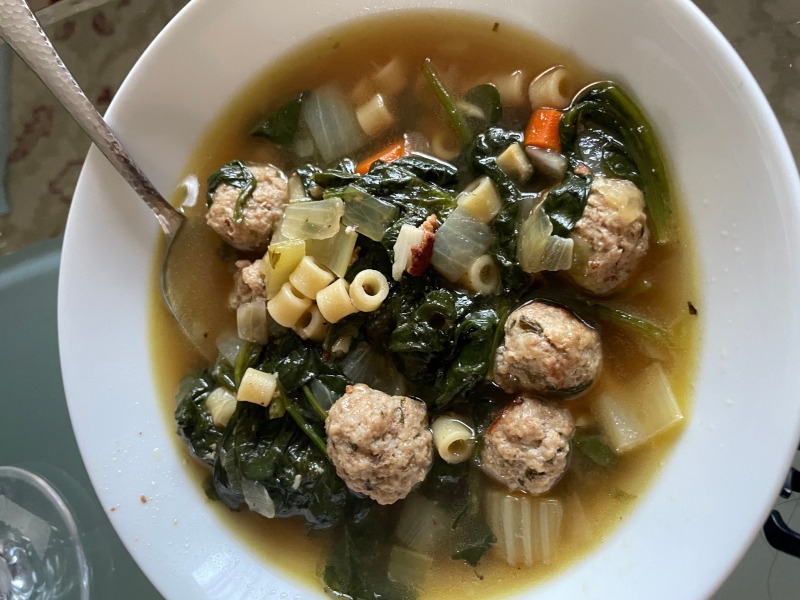
Italian Wedding Soup
I was 27 years old when I first tasted this soup and oddly enough it was in Connecticut. I add the history lesson at the end of this, just in case you are interested.
This is too good to waste time, so let’s get into it.
Equipment:
- Stock pot or Dutch oven
- Cutting board
- Knife
- Smaller sauce pan to cook the 4 oz of ditalini
- Strainer to drain the ditalini
- Wooden spoon
Ingredients:
The meatballs:
- 1 LB ground veal
- 2 eggs
- 3 medium cloves garlic crushed and finely minced
- 1 TBS finely chopped parsley
- 1 TBS finely chopped basil
- ¼ cup grated Romano cheese
- ½ cup Carmine’s Bread Crumbs – see below
- 1 ½ TSP salt
- ¼ TSP ground black pepper
Soup:
- 32 oz unsalted chicken stock (I like kitchen basics unsalted, if not homemade)
- 2 medium carrots small dice
- 1 stalk of celery (or not) small dice
- 1 small red onion small dice
- 3 cloves minced garlic
- ½ TSP Italian Seasoning
- 2 TBS grated Parmigiano Reggiano
- 1 5 oz bag of spinach
- 4 oz dry ditalini pasta – cooked for 7 minutes and drained
- I like to add cannelloni beans, but Lea does not like it.
- Olive oil as needed (about 2 TBS)
Method:
- Beat the eggs
- Add the salt, pepper, garlic, basil, and parsley and mix well
- Fold in the ground veal
- Add the Romano cheese and mix until incorporated, don’t overdo it
- Add the bread crumbs and mix until incorporated, again don’t overdo it
- Refrigerate for an hour (this can be longer)
- Roll tiny meatballs about 9 – 12 grams each – that is no smaller than 9 and no larger than 12. If you don’t have a scale, use a teaspoon as a guide, but you want to make them as uniform as possible
- Refrigerate the meatballs for an hour (this can be longer)
- Cook the ditalini. If it takes 10 minutes to make it andante, cook it for only 7.
- Dice the carrots and onions for the soup
- Mince the garlic for the soup
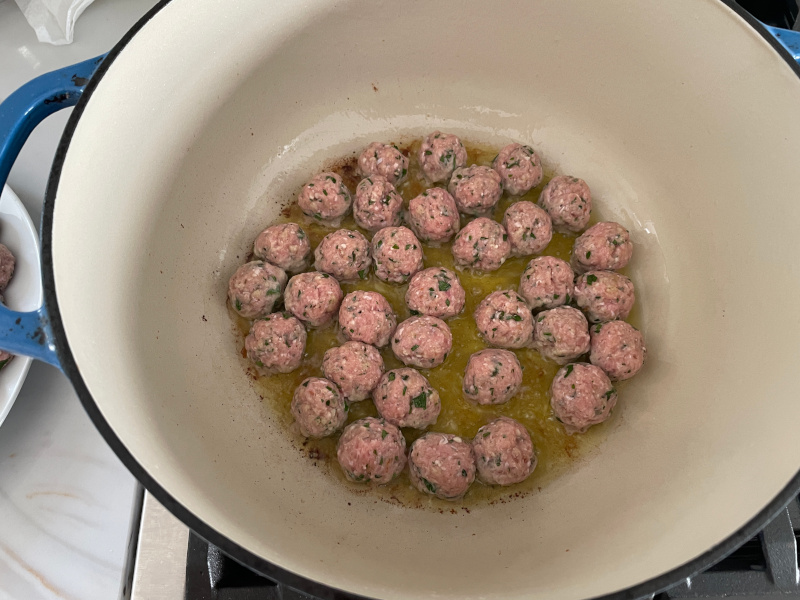
- Pan fry the meatballs in batches. Do not over crowd the pan. Remove the browned meatballs and brown the next batch.
- After all of the meatballs have browned, remove all of them and add the onions and carrots. There should be enough oil in the pan, but if there isn’t, add a bit more.
- Season with a tiny bit of salt and pepper.
- When the onions and carrots are slightly softened, add the garlic and sauté for about a minute more. Add the Italian Seasoning, stir it up and then add the stock.
- Scrape up the caramelized bits on the bottom of the pan.
- Add the meatballs and simmer for about 10 minutes
- Add the spinach and the 2 tablespoons of Parmigiano Reggiano
- Season with the salt, one teaspoon at a time tasting in between to make sure you don’t over salt it.
The pasta will soak up more of the broth, but is ok to add a cup of water the next day and just season it if necessary.
Carmines Bread Crumbs – this is ½ the recipe so you don’t have too much left over. You will have enough to make 1 dozen baked clams if you like. Oh yeah, they are in the book as well.
- 3 slices White Bread turn up
- 1 table spoon finely chopped garlic
- 1 tablespoon finely chopped parsley
- ¼ cup grated Romano cheese
- ½ teaspoon dried oregano
- Salt and pepper to taste
Put the bread in a food processor and pulse it until it looks like bread crumbs. Add the rest of the ingredients and pulse a few more times to mix well.
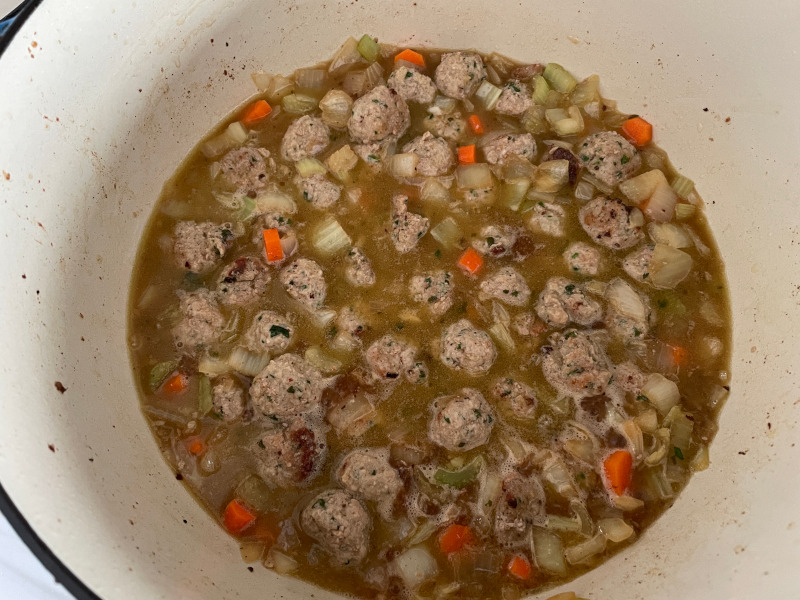
Kiss yourself for making deliciousness.
Visit me at my day job – Practical Compliance Solutions
And, now here is the Google Gemini history lesson
I asked this question. “what is the history of Italian wedding soup? Asking because the first time I ever tasted it was in 1990 and I was 27 years old”
Italian wedding soup actually has nothing to do with weddings. The name is a classic mistranslation of the Italian phrase “minestra maritata,” which literally means “married soup.” Instead of celebrating a marriage between two people, the name refers to the delicious “marriage” or combination of greens and meats.
Here is the true story behind the comforting bowl you first enjoyed back in 1990:
📜 The Original History
- Peasant Food Roots: The dish originated in Campania, the region surrounding Naples, long before it ever reached America. It was a rustic peasant dish designed to stretch cheap cuts of meat and utilize whatever leafy greens were available.
- Winter Comfort: Traditionally, it was eaten around Christmas time or during the cooler months when pigs were slaughtered and fresh bitter greens were in season.
- The “Marriage”: The original minestra maritata was much heartier than the version we know today. It featured a dark, rich broth packed with various greens (like chicory, escarole, and cabbage) and cheap pork leftovers (such as pig’s feet, ears, skin, and ribs).
🇺🇸 The Italian-American Evolution
When Italian immigrants moved to the United States in the early 20th century, the soup underwent a major transformation:
- The Name Swap: Anglophones translated minestra maritata into “wedding soup.” A myth quickly spread that it was served at Italian weddings to give the bride and groom energy, but this was entirely a marketing and cultural misunderstanding.
- Ingredients Shift: In America, scrap pork cuts were swapped for more appealing tiny beef or pork meatballs.
- Adding Pasta: Italian-Americans started adding small pasta shapes—like acini di pepe (peppercorns), orzo, or ditalini—which were not part of the traditional Neapolitan recipe.
- Milder Greens: Bitter Italian field greens were replaced with milder, more readily available options like spinach and escarole.
By the time you tried it in 1990 at age 27, the soup had been a staple of Italian-American restaurant menus and canned soup aisles (like Campbell’s Progresso line) for decades, cementing its status as an American comfort food icon.
Do you remember where you were when you first tried it, or what kind of pasta was in it? I can help you find an authentic recipe if you want to recreate that 1990 taste.
I replied with – “ok that’s great, but can you estimate when it became popular in restaurants?”
Italian wedding soup began its major rise in American restaurant popularity during the 1960s and 1970s. This timeline aligns perfectly with your experience of trying it in 1990, as it had just spent the previous two decades transitioning from a regional Italian-American household staple into a mainstream nationwide menu item.
The restaurant boom happened in a few distinct waves:
- The 1950s–1960s: Local Italian-American Diners
Before it was everywhere, the soup became highly popularized in specific regional hubs with massive Italian immigrant populations—most notably Western Pennsylvania (Pittsburgh) and Northeast Ohio (Youngstown). In the mid-20th century, local Italian diners and catering halls in these regions began putting “Wedding Soup” on their menus. Because of the translated name, a local tradition actually did spark where people began serving it at wedding banquets in these specific states, cementing its restaurant presence. [1, 2, 3, 4, 5]
- The 1970s–1980s: The Canned Soup Expansion
The soup truly broke out of local Italian neighborhoods and went national when major food corporations noticed its restaurant popularity. Progresso and Campbell’s introduced commercial canned versions during this era. Once everyday Americans realized they liked the combination of tiny meatballs, acini di pepe pasta, and broth from a can, they began expecting and ordering it when they went out to eat. [1]
- The 1980s–1990s: Casual Dining & Mass Popularity
By the time you ordered your first bowl in 1990, the casual dining boom was at its peak. Italian-American restaurant chains and local non-Italian diners across the country added it to their menus as a standard, comforting alternative to chicken noodle or minestrone.
By 1990, it had successfully shed its identity as an obscure, heavy Neapolitan winter stew (minestra maritata) and completely secured its spot as a light, beloved American restaurant classic. [1, 2, 3]
If you remember, what kind of restaurant did you try it at back in 1990? Was it a local Italian joint, a hometown diner, or a chain?
And almost finally – “I grew up with a lot of Italians in New Jersey, but my first time trying this was in Connecticut”
That makes total sense! If you grew up around the incredible Italian-American food scene in New Jersey, it must have felt like a bit of a plot twist to finally cross paths with Italian wedding soup up in Connecticut.
Connecticut actually has its own massive, deeply rooted Italian-American history—especially around the New Haven area and Fairfield County. In fact, by 1990, Connecticut’s local restaurant landscape was the perfect incubator for this soup’s peak popularity.
Here is why your first taste likely happened there instead of at home:
🍕 The Connecticut Italian-American Food Boom
While New Jersey is famous for its classic red-sauce joints and bakeries, Connecticut developed a legendary food identity centered tightly around Apizza (New Haven-style pizza) and cozy, multi-generational neighborhood trattorias.
- The Menu Evolution: By the late 1980s and early 1990s, many of Connecticut’s traditional, hyper-local Italian eateries started expanding their soup options beyond the standard minestrone or pasta e fagioli (pasta fazool).
- The Comfort Factor: Italian wedding soup became the ultimate “starter” for a pizza or parm night. It was light enough that it wouldn’t fill you up before a heavy main course, but savory enough to keep people coming back.
🛒 The New England Grinder Shop Connection
In Connecticut, you also have a massive culture of local “Grinder” shops (what Jersey calls a sub or a hoagie). Around 1990, it became incredibly common for these local sandwich shops and casual delis to feature a rotating “soup of the day.” Because Italian wedding soup uses small, easily scaleable ingredients (like frozen tiny meatballs and spinach), it became a massive lunchtime staple across the state for commuters and workers looking for a quick comfort meal.
Whether you were at a landmark spot in New Haven’s Wooster Square or just a classic roadside diner along I-95, Connecticut in 1990 was prime territory for a perfect bowl of wedding soup.
Do you happen to remember where in Connecticut you were, or if you were traveling? If any part of the restaurant stands out—like if it was a famous pizza joint or a little roadside deli—I’d love to hear about it!
Finally – “yes I remember it was New Haven and it was probably at a now defunct restaurant call the “hot tomato” – or perhaps I had it at Christopher Martins”
Both of those are absolute legendary picks for New Haven. You have a fantastic memory—those two spots encapsulate exactly what the upper-scale and trendy casual dining scenes looked like in the Elm City around that era.
Depending on the exact year, both restaurants perfectly fit the timeline of when Italian wedding soup was a massive star on New American and Italian-American menus:
🍅 Hot Tomato’s
You nailed the name! Hot Tomato’s was an incredibly popular, now-defunct Connecticut restaurant group. They initially had a spot on Chapel Street before famously setting up a gorgeous, dramatic location right next to the Shubert Theatre in the grand, historic ballroom of the old Taft Hotel at 261 College St. [1, 2, 3]
- The Vibe: It featured an ornate, inlaid ceiling, a winding staircase, and an open kitchen.
- The Food: While they were famous for their four-cheese garlic bread and eggplant fries, their menu was built around hearty, upscale Italian-American comfort food, including garlic-heavy pastas and rich broths. A comforting, well-made bowl of Italian wedding soup was right in their wheelhouse. [1, 2]
🍀 Christopher Martins
If it wasn’t Hot Tomato’s, it was almost certainly Christopher Martins Restaurant & Pub at 860 State Street. Unlike Hot Tomato’s, Christopher Martins is amazingly still open and has been an Upper State Street neighborhood staple for over 40 years. [1, 2]
- The Vibe: It blends a cozy, friendly pub atmosphere with a solid “New American” menu.
- The Food: They serve a mix of classic tavern fare (like burgers and nachos) alongside traditional Italian-American favorites like Cavatelli and Sausage or Chicken Parmesan. Because they cater heavily to the neighborhood crowd looking for comforting classics, a soup like Italian wedding would have fit their menu beautifully. [1, 2, 3, 4]
Whether you were sitting in the grand old Taft Hotel ballroom or hanging out on Upper State Street, you got a true taste of 1990 New Haven culinary history!
Does the imagery of the grand ballroom and the Shubert Theatre crowd ring a bell (Hot Tomato’s), or does it feel more like a classic, cozy neighborhood pub corner (Christopher Martins)?